Vehicle pricing
Classic Car Paint Job Cost in 2026
Classic car paint is its own market. The cheapest legitimate driver-quality respray starts around $5,000. A real show-quality bare-metal job starts at $12,000 and runs to $25,000. A concours frame-off paint job starts at $25,000 and can reach $60,000+. Here is what each tier actually buys, why classic paint costs what it does, and the single-stage vs modern-urethane authenticity decision.
Updated May 2026
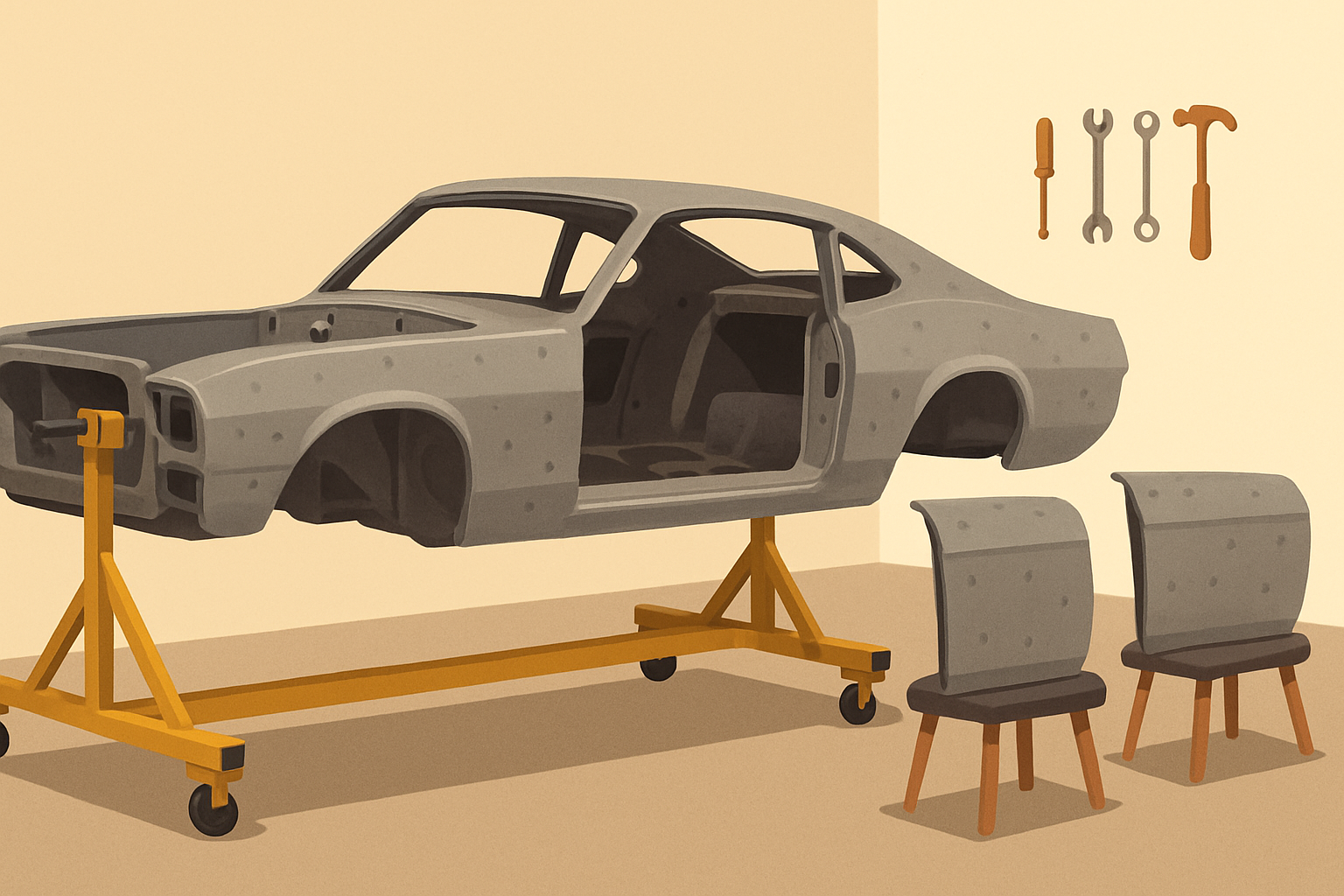
The honest classic car paint price range
A classic car paint job in 2026 starts at $5,000 for the cheapest legitimate driver-quality respray on a small body (a 1965 Mustang or a 1969 Camaro), and runs to $60,000+ for a concours frame-off paint job on a high-value classic. Anything quoted under $4,000 on a classic body should be treated as a yellow flag: either the shop is unfamiliar with classic work, or the prep is being skipped to hit a price.
The reason classic paint costs more is not the paint material. Material cost is roughly $1,000-$2,500 even at the show-quality tier. The cost is labour: a typical American muscle car body has 50 years of dent repair, filler over rust, panel mismatch from prior accidents, and 3-5 layers of previous paint to deal with. A show-quality job addresses all of it, which means 300-500 labour hours at $25-$60 per shop hour. Concours work on a more complex body (a 1958 Corvette with fibreglass, or a 1970 Hemi Cuda with deep colour history) can easily exceed 1,000 hours.
For most classic owners, the sweet-spot tier is the driver-quality respray at $5,000-$10,000. It is a sand-prep modern urethane base-clear job that looks excellent from 10 feet and holds up to weekend driving and the occasional local show. It is the right choice for restomods, weekend drivers, and anyone who wants the car to look good without targeting a national show win. Show-quality and concours are for cars where the paint is judged at events that pay attention to it.
The three legitimate tiers
Driver-quality respray
$5,000 - $12,000Use case: Restomod, weekend driver, 20-footer show car
- Sand existing paint, no bare-metal strip
- Modern base-coat / clear-coat urethane
- Solid colour or factory-matched metallic
- 150-300 labour hours
- Looks great from 10 feet, imperfect up close
High-end / show-quality
$12,000 - $25,000Use case: Show-going classic, high-value driver, period-correct restoration
- Strip to bare metal on at least the major panels
- Block-sand for mirror-flat surface
- Multi-stage clear with wet-sand and polish between
- 300-500 labour hours
- Concours-judge-survivable from 3 feet
Concours / frame-off
$25,000 - $60,000+Use case: Pebble Beach, Amelia Island, top-tier auction prep
- Body fully removed from frame, every panel separated
- Multi-round block-sand with cross-hatching
- Period-correct single-stage if pre-1985, modern if later
- 500-1,200+ labour hours
- Judged paint will hit 95-99 points at major shows
What makes classic paint different
Why a classic paint job is not just a regular paint job
A 1968 Camaro or a 1970 Mustang is not a 2018 Camry with old paint. The body has 50+ years of dent repairs (good and bad), filler over rust, lead solder seams, weld-shrunk panels, and paint layers added by previous owners. Before any colour goes on, the body needs to be assessed and corrected. A driver-quality respray skips most of that. A show-quality job addresses all of it. The difference between $5,000 and $25,000 on the same car is almost entirely body work and prep, not paint.
Single-stage vs modern base-clear authenticity
Cars built before about 1985 used single-stage paint from the factory: pigment, binder, and a small amount of catalyst, sprayed and left to cure. The look (slightly less mirror-flat, slightly warmer in colour, less plasticky) is genuinely different from modern base-clear. A period-correct restoration uses single-stage acrylic urethane for the right look. A restomod uses modern base-clear for durability. Both are valid choices; both cost in the same range; concours judges will reward the authentic choice.
Bare-metal strip is the most expensive step
Chemical strip (dipping) costs $1,500-$3,500 for a typical pony car body, sometimes more with hood, deck, and doors all dipped separately. Media-blast strip (soda or plastic, never glass which warps thin panels) runs $2,000-$5,000. Sand-strip by hand at the shop runs $1,500-$3,000 in labour. Bare-metal strip is non-negotiable on a show-quality job because it reveals the actual body work history and removes 50 years of overspray, but skipping it saves $2,000-$4,000 on a driver-quality job.
Lead-paint hazard on pre-1978 cars
Cars built before 1978 may have lead-content paint and lead-solder body seams. A reputable restoration shop will test before stripping and use proper containment (HEPA filtration, lead-rated respirators) which adds $300-$1,200 to the job in compliance cost. Cheap shops skip the testing and put the painter, the customer, and the next several cars in the booth at risk. Ask explicitly about lead testing on any pre-1978 car.
Insurance and appraised-value implications
Most classic-car insurance policies (Hagerty, American Modern, Grundy) are agreed-value policies based on a recent appraisal. A show-quality paint job typically raises the appraised value by 60-100% of the paint cost on a notable car. Get a current appraisal after the work is done and notify your insurer. Without the updated appraisal, a total-loss settlement will pay the old value even though you put $20,000 into the paint.
Line-item cost breakdown
A high-end classic paint quote should itemise these line items rather than rolling them into one number. If a shop quotes $18,000 with no breakdown, push back. Below are typical 2026 ranges sourced against Hagerty's restoration cost coverage and published restoration shop hourly rates.
Strip and prep
- Chemical dip (full body): $1,500 to $3,500
- Media blast (soda or plastic): $2,000 to $5,000
- Hand sanding to bare metal: $1,500 to $3,000 in labour
- Lead-content testing and containment: $300 to $1,200
- Rust repair / panel replacement: $500 to $8,000+ depending on condition
- Body filler work (block-sanded to flat): $1,500 to $5,000
Paint and clear
- Primer (epoxy + filler primer + block-sand): $400 to $1,200
- Period-correct single-stage urethane (e.g. PPG Concept): $600 to $1,500 in materials
- Modern base-clear urethane (e.g. PPG Envirobase, Glasurit): $800 to $2,000 in materials
- Application labour (full body): $3,000 to $12,000
- Wet-sand and polish between coats: $800 to $4,000
Refit and finish
- Body to frame refit (if frame-off): $1,500 to $4,000
- Trim refit (chrome, badging, mouldings): $500 to $2,500
- Door and panel re-hang and gap-set: $500 to $2,000
- Final detail and ceramic coating: $300 to $1,500
Insurance, appraisal, and resale
A show-quality paint job typically adds 60-100% of its cost to the appraised value of a notable classic. A $15,000 paint job on a numbers-matching Mustang Mach 1 can add $9,000-$15,000 to appraised value. On a less collectible car (a project-grade Camaro or a base Mustang), the appraisal uplift may be smaller in absolute dollars but proportionally similar.
Hagerty Insurance, American Modern, and Grundy all offer agreed-value classic-car policies. After a major paint job, get an updated written appraisal from a qualified appraiser (typically $200-$500) and submit it to your insurer along with photos and shop invoices. Without that update, a total-loss claim pays the pre-paint value.
On resale, a quality paint job almost always pays back its cost on a notable classic. On a less collectible car, the resale value of a $15,000 paint job is closer to $8,000-$11,000. Paint your classic because you want to enjoy it, not as an investment, unless the car is rare enough that paint quality moves the auction needle.
Classic car paint FAQ
How much does a classic car paint job cost in 2026?+
A driver-quality respray on a classic car runs $5,000 to $12,000. A high-end show-quality paint job is $12,000 to $25,000. A concours frame-off restoration paint job starts at $25,000 and can run to $60,000 or more on a complex multi-colour or rare-make car. The cost is mostly labour (200 to 1,200 hours) and bodywork, not paint material.
Should a classic car be painted with period-correct single-stage or modern base-clear?+
For a concours restoration of a pre-1985 car, period-correct single-stage acrylic urethane is the right choice and is what judges reward. For a restomod or weekend driver, modern base-clear is more durable, easier to maintain, and easier to repair. Both cost in the same range. The decision is about authenticity vs longevity, not money.
Is bare-metal strip really necessary on a classic restoration?+
On a show-quality or concours job, yes. Strip reveals 50 years of body work history including filler over rust and previous repair quality. On a driver-quality respray you can skip strip and sand the existing paint instead, which saves $2,000-$4,000 but means you do not know what is underneath. If the car has known good bodywork history, sand-prep is acceptable for a driver.
Why is classic car paint so much more expensive than modern car paint?+
Three reasons. First, body work: a 50-year-old car needs 50-500 hours of body work before paint can go on, which modern cars do not. Second, strip-to-bare-metal is standard at show quality, doubling the prep hours. Third, the paint application itself runs 100-500 hours instead of the 25-50 typical of a modern mid-tier respray. Material cost is similar to modern paint; the labour difference accounts for the price gap.
Do I need to update my insurance after a classic car repaint?+
Yes. Almost all classic-car insurance policies are agreed-value, meaning the payout in a total loss is the value documented on a recent appraisal. After a $15,000 paint job that adds $10,000+ to the car's value, get a fresh appraisal and submit it to your insurer. Without the update, a total loss will pay the pre-paint value.
How long does a high-end classic car paint job take?+
A driver-quality respray takes 4-8 weeks once the car is in the shop. A show-quality paint job with bare-metal strip and full body work takes 4-9 months. A concours frame-off paint job is typically 9-18 months because the work is done alongside frame, suspension, and mechanical restoration. Plan your insurance, storage, and registration accordingly.